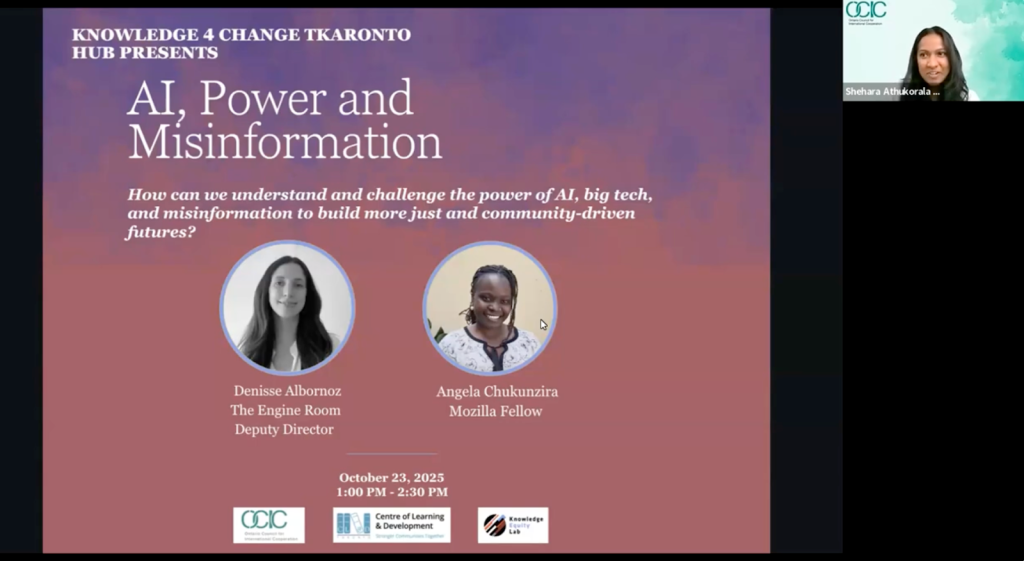
On October 23, 2025, the Knowledge 4 Change (K4C) Tkaronto Hub hosted its first fall webinar, “AI, Power, Hidden Labour and Misinformation,” as part of the 2025–2026 Innovation Lab series.
The session brought together students from the University of Toronto Scarborough, community members from the Centre for Learning and Development’s Immigrant Women’s Integration Program, and members from the Ontario Council for International Cooperation.
Designed as an exploration of how we can better understand artificial intelligence, challenge the power of big tech and misinformation, and imagine more just, community-driven technologies and futures, the webinar featured guest talks by Angela Chukunzira and Denisse Albornoz.
Angela Chukunzira is a Mozilla Fellow and has been involved with social movements and their communicative practices in Nairobi, Kenya. Her work examines the intersection of labour within the digital economy, specifically with location-based platform workers and the “invisible” tech workers. Her previous research focuses on youth perceptions of digitization, unemployment and what the future of work(ers) looks like.
Angela’s presentation shed light on the “invisible workforce” powering big tech’s AI systems, a labour force that is systematically exploited and intentionally misclassified as contractors, stripping them of labour rights and protections. These workers — data labellers, content moderators, and platform workers — are often exposed to disturbing and traumatic material without access to mental health support. Many are even monitored through surveillance software within their own homes, eroding the boundary between work and personal life.
Angela underscored how these extractive systems perpetuate racial capitalism and colonial histories. Extractivism, she explained, operates on multiple layers: the extraction of natural resources, such as minerals, water, and energy that devastate ecosystems; the extraction of labour from underpaid and unprotected workers; and the extraction of data and knowledge from communities without consent.
Ultimately, Angela called for worker resistance and solidarity, highlighting initiatives such as the Africa Tech Workers Movement and experiments in cooperative, worker-owned AI models, reimagining AI as a collective human creation.
Denisse Albornoz is the Deputy Director of the Engine Room and she is based in Peru. She is a researcher interested in the societal impact of technology, particularly on marginalized communities. Using justice and community-centred methodologies, she has co-designed programs with diverse groups, including scientists, artists, and activists, to mitigate online harms and advance the safe and equitable use of technology.
Denisse invited us to reflect on the images and emotions that come to mind when we think about artificial intelligence. She asked: Who holds the power to speak about technology with confidence? And how might we foster that confidence in individuals and communities challenging the restrictive narratives that manufacture exclusion, isolation and perpetrate techno-fascism?
Her presentation disrupted dominant narratives of AI that frame it as overly complex and inevitable, stories that, she argued, limit human choice and obscure the role of community in shaping technology. Denisse offered a framework for engaging with AI through three acts of reclamation: reclaiming choice (by slowing down and saying no more often), reclaiming plurality (by valuing diverse knowledges), and reclaiming imagination (by centering justice, care, and well-being in how we design and use technology).
She emphasized the importance of grounding these ideas in community-centered practices beginning from lived, embodied experiences with technology and its impact on daily life. Drawing on feminist, decolonial, arts-based, and community-led projects, Denisse illustrated how technology can become a creative, collaborative process designed to serve communities, when the locus of control moves from extraction to participation.
In conclusion, a quote shared during the webinar captured the spirit of both presentations:
“Remember to imagine and craft the worlds you cannot live without, just as you dismantle the worlds you cannot live within.” — Ruha Benjamin
This provocation beautifully encapsulates the call to action that both Angela and Denisse left us with: to dream, design, and build technologies, and futures, rooted in justice, care, and community.
To continue exploring these ideas, we invite you to watch the full webinar here: https://www.youtube.com/watch?v=XMh1dA6O-fs